

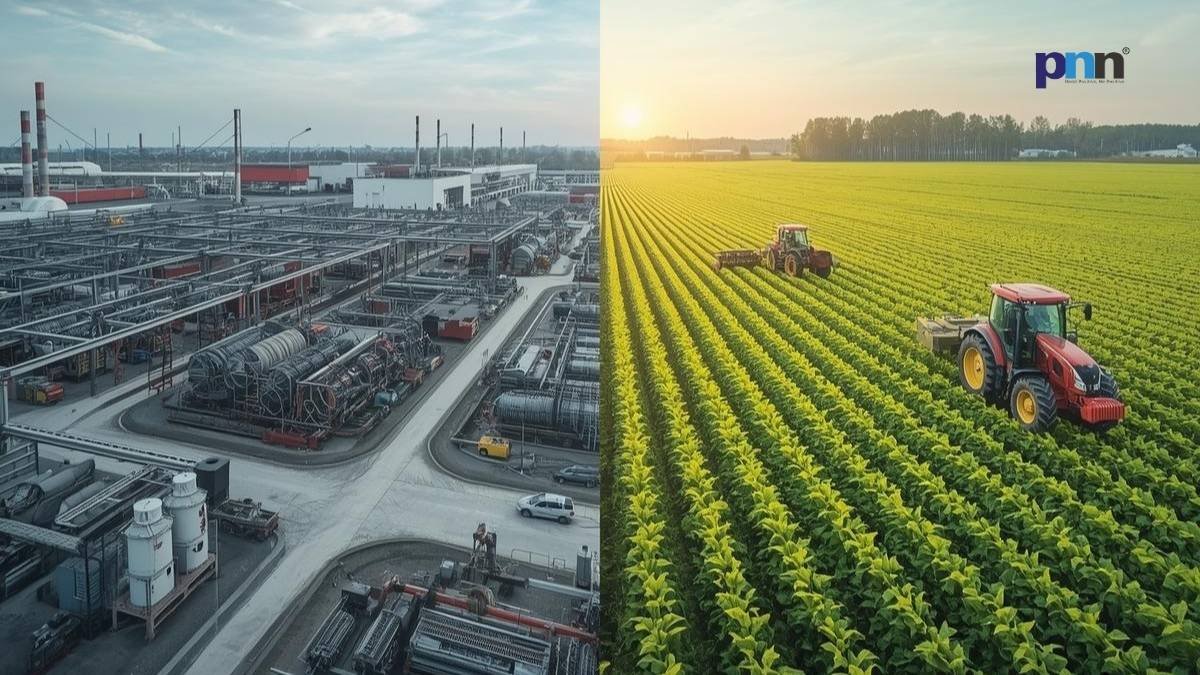
New Delhi [India], March 14: Manufacturing vs agriculture growth in India is suddenly the story nobody in policymaking circles can ignore. Factories are humming at record levels while farm growth has slowed enough to raise eyebrows.
Manufacturing vs Agriculture Growth India
Manufacturing vs agriculture growth India is turning into one of those economic contrasts that makes policymakers pause for a second. Maybe two.
Look at the data. Factories are pushing ahead at impressive speed. Agricultural growth, meanwhile, has slowed enough to raise some uncomfortable questions.
And honestly, this kind of imbalance wasn’t supposed to be this obvious.
Manufacturing sentiment has reached record highs. Production lines are active. Companies are expanding output. Hiring intentions are rising.
But agriculture, despite producing massive quantities of food, is seeing weaker growth.
Which is… interesting. Slightly ironic too.
India feeds itself just fine. Yet the farm economy isn’t expanding nearly as fast as the industrial one.
Factories Are Running at Full Speed
Let’s start with the good news. And there’s quite a bit of it.
The Federation of Indian Chambers of Commerce & Industry manufacturing survey shows something pretty striking. The FICCI Manufacturing Index hit an all-time high in the third quarter of FY26, covering October to December 2025.
That doesn’t happen casually.
A massive 91 percent of manufacturers reported either higher or stable production levels. Think about that for a second. Nine out of ten companies are basically saying, yeah, business is good or at least steady.
Capacity utilization across major industries is sitting at around 75 percent.
Which, if you’ve followed industrial cycles before, is a strong number. Factories don’t operate near that level unless demand is solid. And consistent.
In other words, machines are running. Workers are busy. Orders are coming in.
It’s a good place to be.
Industrial Production Confirms the Momentum
Survey sentiment is nice. But hard numbers matter more.
And the numbers line up.
India’s Index of Industrial Production, the IIP, grew 4.8 percent year-on-year in January 2026. Not explosive growth. But healthy. Steady. Reliable.
The interesting part is where the growth is coming from.
Basic metals production jumped 13.2 percent. Motor vehicles expanded 10.9 percent. Infrastructure and construction goods surged 13.7 percent.
That last number is worth lingering on.
Construction goods rising at that pace usually signals one thing. Infrastructure work is moving. Roads, bridges, housing projects, rail expansion. All of it needs steel, cement, heavy materials.
And those industries feed directly into manufacturing activity.
So yes, factories are busy.
Really busy.
Corporate India Is Benefiting
This manufacturing momentum is spilling into corporate earnings as well.
Data from the Reserve Bank of India shows that manufacturing companies led revenue growth across India Inc. during the third quarter of FY26.
Overall corporate revenues grew 10.1 percent, with manufacturing doing a big chunk of the heavy lifting.
Which makes sense.
Manufacturing has this multiplier effect. A factory doesn’t operate in isolation. It pulls in raw materials, logistics, engineering services, suppliers, contractors. Whole ecosystems get activated.
When factories grow, economic activity spreads outwards like ripples in water.
That’s what’s happening now.
Agriculture Growth Slows
Now here’s the other side of the story. The quieter side.
Agriculture growth in the latest quarter came in at 1.42 percent.
Yes, you read that right.
Among all major sectors of the economy, agriculture is currently the slowest growing.
For the full fiscal year FY26, agricultural growth is projected at 2.5 percent. That’s a noticeable drop from 4.3 percent recorded in FY25.
Now look, agriculture is complicated. Weather plays a role. Global commodity prices play a role. Domestic policy, irrigation conditions, input costs. It’s never just one factor.
But still. The slowdown is visible.
And when agriculture slows, rural demand often follows. That’s something economists watch closely.
Because rural consumption drives a lot of everyday economic activity.
Allied Sectors Step In
But here’s where the story gets a little more nuanced.
While traditional crop farming isn’t growing very fast, allied agricultural sectors are actually expanding much faster.
Livestock production is growing 7.1 percent. Fisheries are expanding 8.8 percent.
Those are strong numbers.
What it suggests is something economists have been talking about for years. Rural income is slowly diversifying away from pure crop farming.
Dairy, poultry, and aquaculture. These activities tend to generate steadier income streams. Less vulnerable to weather shocks.
Farm households are adapting. Maybe gradually. Maybe unevenly. But adapting nonetheless.
And that shift is starting to show up in national data.
Record Foodgrain Production
Here’s the twist though.
Despite slower agricultural growth rates, India has actually produced record foodgrain output.
According to the Press Information Bureau, total foodgrain production reached 357.73 lakh tonnes in 2024–25.
Which is enormous.
So yes, agriculture is growing more slowly. But production volumes are still massive.
That’s the strange part of the story.
The country is producing more food than ever before… yet the sector’s growth rate is cooling.
Economic data can be weird like that sometimes.
What This Divergence Means
So what does manufacturing vs agriculture growth India actually tell us?
Maybe it’s simply the natural evolution of a developing economy.
Historically, as countries grow richer, manufacturing and services begin to outpace agriculture. The structure of the economy shifts. Labor moves. Investment flows into industry.
India might be moving along that path.
Factories expand. Infrastructure projects accelerate. Industrial clusters grow. Meanwhile agriculture gradually becomes more specialized.
But here’s the important bit.
Agriculture still supports a massive share of India’s population.
So while manufacturing strength is fantastic news for economic growth, policymakers still need to keep rural incomes stable.
Because factories build GDP.
But farms… farms build social stability.
And both matter.
