

Noida (Uttar Pradesh) [India], October 19: Is journalism and mass communication a good career? Yes, but not in the way most guides describe. The field has grown far past the TV reporter image. At AAFT Noida, graduates move into newsrooms, digital media, PR and content roles, and the BJMC course at AAFT Noida (a three-year BA in Journalism and Mass Communication) opens all these lanes after 12th, not just one.
Journalism today is bigger than the evening news. It runs across TV, print, digital, radio and brand media. So the honest answer to the career question is layered. Some graduates report the news. Many others build careers around it.
AAFT Noida, the Asian Academy of Film & Television’s campus at Noida Film City in Delhi NCR, offers the three-year BA in Journalism and Mass Communication (BJMC) and the MA in Journalism and Mass Communication through its School of Mass Communication. Admissions for the 2027 batch are now open.
Is Journalism and Mass Communication a Good Career After 12th?
Yes. Digital media is now India’s largest media segment, and news, brands and agencies all need trained communicators. That makes journalism and mass communication a strong, modern choice after 12th, especially for students ready to work across digital, video, audio and brand media.
Pay in the media depends on the portfolio more than the degree. Freshers usually start on modest salaries, and those who build strong digital, video or PR work move up faster.
The latest industry data shows where the growth is:
- India’s media and entertainment sector grew 9% to ₹2.78 trillion in 2025 and is forecast to reach ₹3.3 trillion by 2028 (FICCI-EY 2026).
- Digital media crossed ₹1 trillion in 2025 and is now the largest segment, ahead of television (FICCI-EY 2026).
- Advertising grew about 13% to ₹1.5 trillion in 2025, and digital took 63% of that spend (FICCI-EY 2026).
- Brands, agencies and startups now hire journalism graduates for content, PR and social media work, well beyond newsrooms.
Where Do Journalism Graduates Work Today?
Most graduates no longer start in a single TV newsroom. They join digital news desks, video teams, PR agencies, brand content teams, podcasts and creator businesses.
The reason is where the money goes. In 2025, digital advertising rose 26% to ₹947 billion, according to the FICCI-EY 2026 report. Jobs follow that spend, so digital, video and verification skills now count as much as classic reporting.
What Jobs and Salary Can You Expect?
Pay grows with your skills and your portfolio. These roles are the common paths after a journalism and mass communication degree.
| Career Role | Where They Work | Typical Salary (industry estimate) |
| Reporter / Correspondent | News channels, newspapers, wires | ₹3–6 LPA |
| Digital Journalist | News sites, brands, startups | ₹4–8 LPA |
| PR / Corporate Communication Executive | Agencies, corporates, consultancies | ₹4–9 LPA |
| Podcast / Audio Producer | Audio platforms, radio | ₹3–7 LPA |
Senior editors and communication leads usually earn ₹10 LPA and above. These are industry estimates, not guaranteed outcomes.
What Tools and Specialisations Can You Master in a BJMC Course?
A BJMC course is not only about theory. You also master the tools that real media teams use every day. You then pick a specialisation that fits your strengths. This is where a journalism degree turns into a career direction.
The tools you learn to use include:
· Video and broadcast. Adobe Premiere Pro and DaVinci Resolve for video editing and news packages.
· Audio production. Multi-track recording and podcast editing tools for radio and audio.
· Design and graphics. Adobe Photoshop and Canva for visual storytelling and social creatives.
· Digital publishing. WordPress and content management systems used by real news sites.
· Social and analytics. Social scheduling, SEO basics and analytics tools that track reach.
· AI-assisted media. AI tools for research, transcription, captions and faster first drafts.
Within the course, you can also lean into a specialisation:
· Broadcast journalism. News anchoring, field reporting and live production for TV and OTT.
· Digital journalism. Reporting, writing and content strategy for news sites and brands.
· Public relations. Media relations, brand messaging and campaign communication.
· Radio and podcasting. Show production, scripting and independent audio storytelling.
· Film and media research. Documentary, media research and long-form storytelling for film and OTT.
You do not have to pick a lane on day one. The early terms build shared skills across all of them. As your interest sharpens, you focus on your projects and internship. So the course lets you test directions before you commit.
Which Journalism Degree Should You Choose — BA or MA?
AAFT Noida offers a clear route at both levels, so you can choose by your goal and your stage. The BA builds strong foundations across news, digital, PR and broadcast. The MA is for deeper reporting, media strategy and leadership roles. Students from any stream can apply.
| Programme | Duration | Best For |
| BA in Journalism and Mass Communication | 3 Years | News, digital, PR and broadcast foundations |
| MA in Journalism and Mass Communication | 2 Years | Advanced reporting, strategy and media leadership |
If you are starting right after 12th, the BA is the natural entry point. If you already hold a degree, the two-year MA in Journalism and Mass Communication sharpens your edge for advanced reporting, media strategy and leadership roles. Both routes give you studio time, real projects and a portfolio.
Eligibility is a 10+2 pass with 50% marks, or 45% for reserved categories. Admission is through the AAFT Global Entrance Test (GET). PG applicants need a bachelor’s degree.
What Does a Journalism and Mass Communication Course Cover?
The course covers the full craft of media work. You learn news reporting, writing and editing first. Then you move to digital journalism, TV production and radio. You also study PR, advertising, media laws and ethics.
Camera work, lighting, video editing and documentary making are part of it. So are content creation, media research and event coverage. Each subject maps to a real career direction. So you can shape a focus as you learn.
The course also keeps pace with how media now works. You study data-led reporting, mobile journalism and social-first video. You learn to verify sources and spot misinformation, a core newsroom skill today. AI tools for transcription, captions and research are taught alongside those verification habits.
How AAFT Noida Trains You for Real Newsrooms?
AAFT Noida follows a 70:30 practical model. That means most of your time is spent doing real media work. You report, shoot, edit and present, not just read theory.
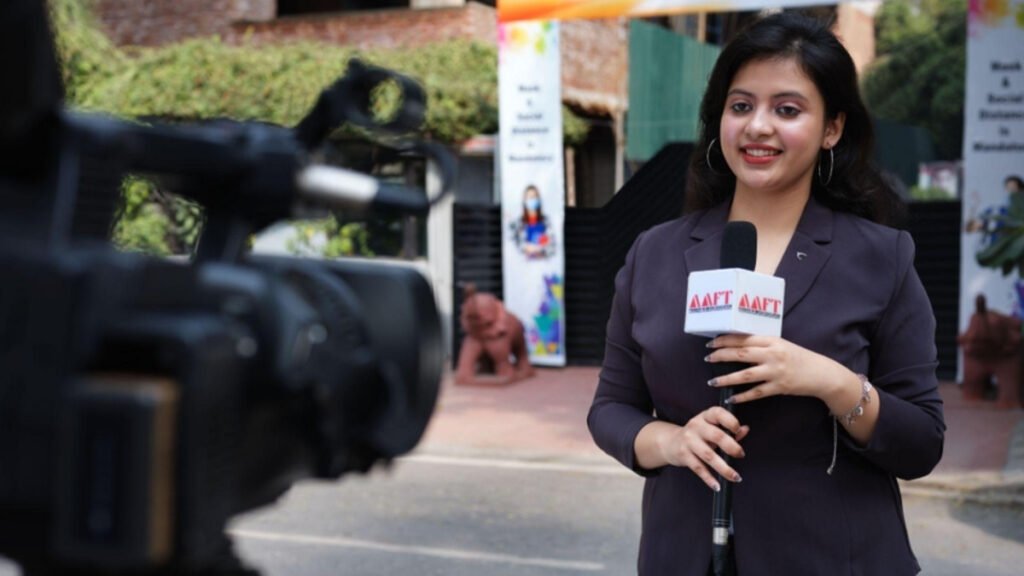
Students work through newsroom simulations and studio projects. The campus has TV studios, radio labs and editing suites. A live campus channel and OB van add real field practice. So you build a portfolio before you graduate.
Learning does not stop at the campus gate. Students cover real events, festivals and press interactions during the course. Guest sessions bring in editors, anchors and PR leaders from the industry. Internships then turn classroom skills into real newsroom experience.
Why Choose AAFT Noida for Journalism?
Location is a real advantage here. The campus sits in the Delhi-NCR belt, a major hub for news, digital and PR. So students are close to the newsrooms and agencies that hire. That access shows up in guest talks, internships and live coverage.
The teaching model is built around doing, not just watching. You work across TV, radio, print and digital in one course. You also join a large alumni network across Indian media. So you graduate with a portfolio, contacts and a clear direction.
Who Will Teach You?
The School of Mass Communication is led by working media professionals. You learn from people who have built real careers in news.
· Industry Dean. Faye D’Souza is one of India’s best-known independent journalists.
· Joint Dean. Dr. Syed Nawaz Ahmad brings over 19 years in media and academia, with newsroom and radio experience.
· HOD. Harinder Kumar leads the department with deep newsroom and teaching experience.
The wider faculty includes Geeta Chaudhary, Lubna Fatima, Mehak Zaidi and Anoop Ray. All are active in media and communication practice. So you learn current methods, not dated ones.
In Their Own Words
Akshay Marwah, CEO, AAFT Noida, said: “Students often ask if journalism is still a good career. Our answer is simple. It is, and it now offers more paths than ever. Our graduates work in newsrooms, digital teams, PR and content roles. We train them for all of it, not just one job. That is the career pathway we care about.”
Where Do AAFT Noida’s Media Graduates Get Placed?
The media hires on your body of work, not just your marks. According to AAFT, its graduates have joined news organisations including Aaj Tak, Zee News, News Nation, WION and Dainik Jagran, as well as digital desks, PR teams and audio roles. The Career Resource Cell supports students with reel reviews, mock interviews and industry referrals.
Internships often act as the first step into a full-time role. Many students convert a strong internship into a job offer. Others move into PR, brand content or the creator economy after graduating. So the paths stay open, whichever lane you choose.
More detail on the programs is on the AAFT School of Mass Communication page.
How to Apply for the 2027 Journalism Programs?
Applying is a short, four-step process. Start early, as seats for 2027 are limited.
1. Register online for the AAFT Global Entrance Test (GET).
2. Check eligibility: a 10+2 pass with 50% marks, or 45% for reserved categories.
3. Choose the BA or the MA; the MA route needs a bachelor’s degree.
4. Sit the GET, then confirm your seat early at admissions.aaft.com.
Frequently Asked Questions
Is journalism still a good career with AI?
Yes. AI speeds up transcription and first drafts, but reporting, verification and judgement remain human skills that employers hire for.
What is the difference between journalism and mass communication?
Journalism focuses on news. Mass communication also covers PR, advertising, corporate communication and content.
Can I apply from the science or commerce stream?
Yes. Students from any stream can apply.
How long are the BA and MA courses?
The BA in Journalism and Mass Communication is three years and the MA is two years.
About the School of Mass Communication at AAFT Noida
AAFT Noida’s School of Mass Communication trains reporters, anchors and communicators for a fast-changing media world. It sits within an institute that carries a 33-year legacy in India’s media and entertainment education.
The Delhi-NCR location is a real edge here. It puts students close to national newsrooms, agencies and studios. Teaching is led by working editors, anchors and media practitioners. A 37,000-strong alumni network now works across the creative industries.
The aim stays steady. AAFT Noida wants graduates who can lead across news, digital and PR.
For Admission and Media Inquiries, Contact:
AAFT Noida
FC-14/15, Sector-16A, Noida Film City, Uttar Pradesh, India
Phone: 08062911638 / 08062911639 / 09811014536
Email: help@aaft.com
Website: www.aaft.com
Sources: FICCI-EY Media and Entertainment Report 2026 (March 2026). Salary ranges are industry estimates, not promised outcomes.
If you object to the content of this press release, please notify us at pr.error.rectification@gmail.com. We will respond and rectify the situation within 24 hours.
