

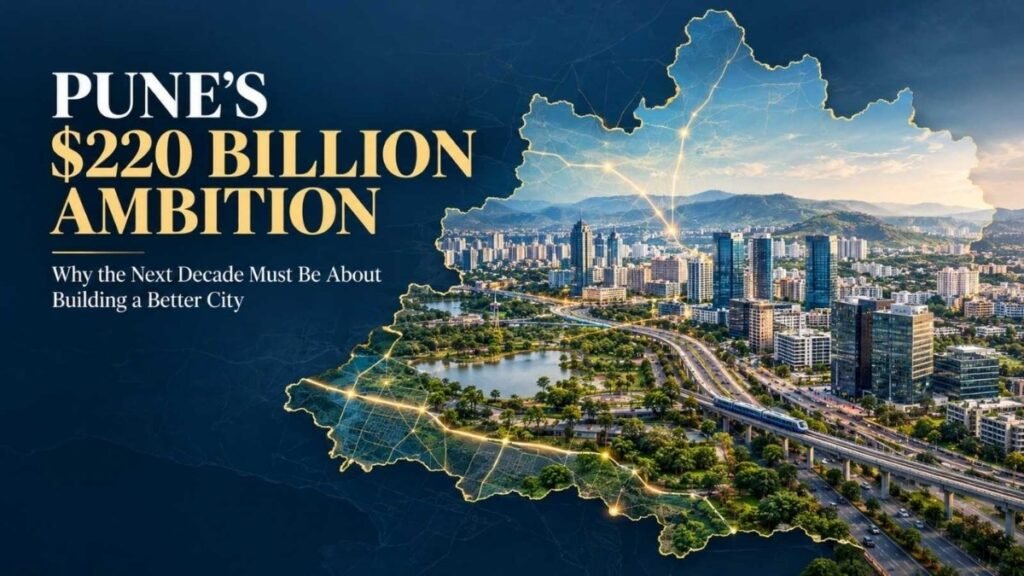
The Maharashtra government’s vision of making Pune the $220-billion economy by 2036 is a dream come true for the city. It’s a time to reflect on what kinds of cities and urban regions Pune will be in the next decade.
Pune (Maharashtra) [India], October 28: Time is crucial in the development of Pune. The city and the surrounding economic area have become an important hub for manufacturing, Information Technology, Engineering, Education and entrepreneurship. A new economic aspiration is driving its next steps in growth.
The Maharashtra government’s vision of making Pune the $220-billion economy by 2036 is a dream come true for the city. It’s a time to reflect on what kinds of cities and urban regions Pune will be in the next decade.
The report said the proposed roadmap has 58 priority projects in various areas including manufacturing, electric vehicles, engineering, defence, robotics, electronics, semiconductors, biotechnology and others. The plan’s target is to boost the economic growth rate of the region from around 6-6.5% to 10% and create up to 20 lakh new employment opportunities. These are still suggested targets – which will be dependent on implementation. The article was picked up from The Times of India.
The effects of industrial growth reach far beyond Pune. Economic development this large will impact where people work, where families want to reside, how they travel to work and their expectations of the communities in which they live.
The true challenge isn’t just to develop Pune’s economy, it is to make sure the physical development of the area matches the economic aspirations.
Economic Growth Will Reshape Pune’s Residential Landscape
Each of the main employment hubs generates a larger market for homes.
Professionals, entrepreneurs, skilled workers and supporting industries come to businesses as the businesses grow. These populations don’t just need jobs. They require housing, schools, health care, shopping, parks and dependable transportation.
This already exists, but will be reinforced over the next ten years by Pune’s proposed growth roadmap, which will create a stronger link between jobs and housing. The extent and the distribution of the new residential demand, however, will depend on the projects that are developed, the job distribution throughout the region and the readiness of the infrastructure to accommodate new development.
This places a significant responsibility on the real estate industry – grasping the economic activity and its implications on the demand for various types of housing.
Technology professionals have different requirements than a manufacturing worker, or young family. For some households, the convenience of workplaces will be a priority, for others, access to educational facilities, open space, community facilities or public transport.
In the context of a growing economic area, an economically diverse residential ecosystem is needed, which is supported by well-designed planning and infrastructure.
The Next Development Phase Must Be Led by the Infrastructure
The proposed growth plan is very mobility-focused.
The roadmap proposes a 250km long Metro network, 11 railway projects, 13 road projects, a fleet of upto 14,000 buses and six multimodal transport hubs. Its aim is also to boost the proportion of trips made daily by public transport from the 13% currently reported to 50%. These are suggested interventions and not an account of existing infrastructure. From: The Times of India
This is important because cities aren’t just about opportunities, they’re about how easily people are able to access those opportunities.
The planning of employment centres, residential neighbourhoods and transport networks, when aligned together, allow for more practical options in terms of where to reside and how to commute. Improved public transportation, which is accessible, dependable, and well connected, can also help to decrease private car usage.
Infrastructure is part of a place’s longer term setting, from a real estate point of view. However, developers and homebuyers need to separate out those projects that are in operation, from projects that are being built and proposals that haven’t yet been put into operation.
Any assessment that is credible must take into account what is present now as well as what is being planned for tomorrow in any location.
Beyond Jobs, the Future of Pune Relies on More
The government has projected jobs of up to 20 lakh, which is an important measure of the scope of economic ambition. The plan also aims to draw investments into new areas of business, establish capability centres all over the world and promote start-ups.
However, jobs are not the only indicator of urban development.
The quality of life enjoyed by the workers who fill these positions will also be crucial. In addition to being a place that is appealing to talent, a region must offer environments that enable people to establish stable, satisfying lives.
This means having access to appropriate housing, education, healthcare, recreation and public spaces. It also covers the day-to-day realities of urban living – the time spent commuting, the services available in the community, and the opportunities to meet family and friends.
It is here that urban development and real estate planning meet.
The challenge should be to develop residential places that meet the demands of an evolving population, not just housing as a product. Economic development can be complemented by well planned neighbourhoods to enable people to access opportunities and support the day to day needs of life.
In What Ways Is Regional Planning Important?
Pune can’t be seen just in the municipal city.
The Pune Economic Region covers the areas under the Pune Municipal Corporation, Pimpri-Chinchwad Municipal Corporation and Pune Metropolitan Region Development Authority. Economic activity, jobs and housing demand frequently span these administrative lines.
This is especially significant in terms of coordination.
Expansion of industries in a particular location may affect the demand for housing in the surrounding neighbourhood. A transport corridor has the potential to affect commuting patterns in more than one jurisdiction. New jobs and job centers can generate demand for education and health care, retail and public services beyond their catchment area.
Independent plans for these developments could leave the region with opportunities missed to use land, infrastructure and public investment more effectively.
Integrated regional planning provides an opportunity to think about these relationships in an integrated way. It can contribute to the integration of transport, housing, job centers, environmental considerations and key services in a wider development context.
The coming decade offers Pune a chance to further improve this coordination in the region’s growth.
Real Estate Developers Play a Part in Forming This Future
With the changing economic landscape of Pune, the job of real estate developers should go beyond building one building.
Development decisions shape the form of neighbourhoods, the uses of open space and the ways that people experience neighbourhood space. Today’s planning quality could determine a community’s function for many years.
That requires a longer term development plan.
Developers are responsible for taking into account how a development fits into the wider infrastructure, and the needs of future residents and the facilities needed to provide for a functioning neighbourhood. Some of the elements of this responsibility include thoughtful site planning, appropriate density, and shared spaces and long-term maintenance that are accessible.
This applies to choices of where to live, too. Growth corridors are assessed for their existing and future economic activity, infrastructure, access to services and development potential, rather than just because they “have the potential to appreciate in property value.
There is no economic objective that can ensure the success of a specific real estate investment. It can offer a bigger circle of decisions that can be made on an informed basis.
At Pharande Spaces, we have come to the realization that development that is responsible must not only consider the project in its immediate context but also the overall urban context as well. This is going to become an increasing factor as Pune continues to grow.
The Growth Must Also Be Sustainable
While growth provides opportunities, it also generates a strain on land, water, transport and other critical resources.
The long-term management of these resources needs to be planned for a region where significant industrial and population development is anticipated. Water security, environment protection, efficient mobility and the preservation of nature assets do not come secondary, but they are essential to the urban growth’s sustainability.
Not all the most successful cities are necessarily the quickest growing. The ones that bring improvement and a more functional life to their citizens through growth are these ones.
For Pune, it is about making sure that the infrastructure investment process, along with the housing development process and environmental priorities are going hand-in-hand. It also involves measuring progress by outcomes which people experience in their everyday lives and not just by economic indicators.
The Next 10 Years Will Shape the Urban Landscape of Pune
The plans to develop the Pune economic region of $220 billion by 2036 reflect the confidence in the economic potential of the region. The proposed investments and projects provide a blueprint for further building up industries, increasing jobs and connectivity.
The real challenge is implementation; the extent to which projects are actually put into practice, how well various agencies coordinate, and how adequately infrastructure and public services are provided to match growth.
The message for the real estate industry is clear. In the future, developers will have to be more mindful of the linkages between employment, housing, mobility and the planning of communities in Pune.
For home buyers, it will be more critical to assess the location as part of the whole, looking at what they need now and how good the urban ecosystem is around them.
I think the one thing that will last the longest in a development is understanding the lifestyle of a city’s residents, its work population and its growth.
The $220 billion ambition of Pune is more than about the economy’s size. It is a chance to create a region where economic growth and the quality of life go hand-in-hand.
This is the benchmark for the development of Pune in the next ten years.
By Anil Pharande, Founder & Chairman, Pharande Spaces
If you object to the content of this press release, please notify us at pr.error.rectification@gmail.com. We will respond and rectify the situation within 24 hours.
