

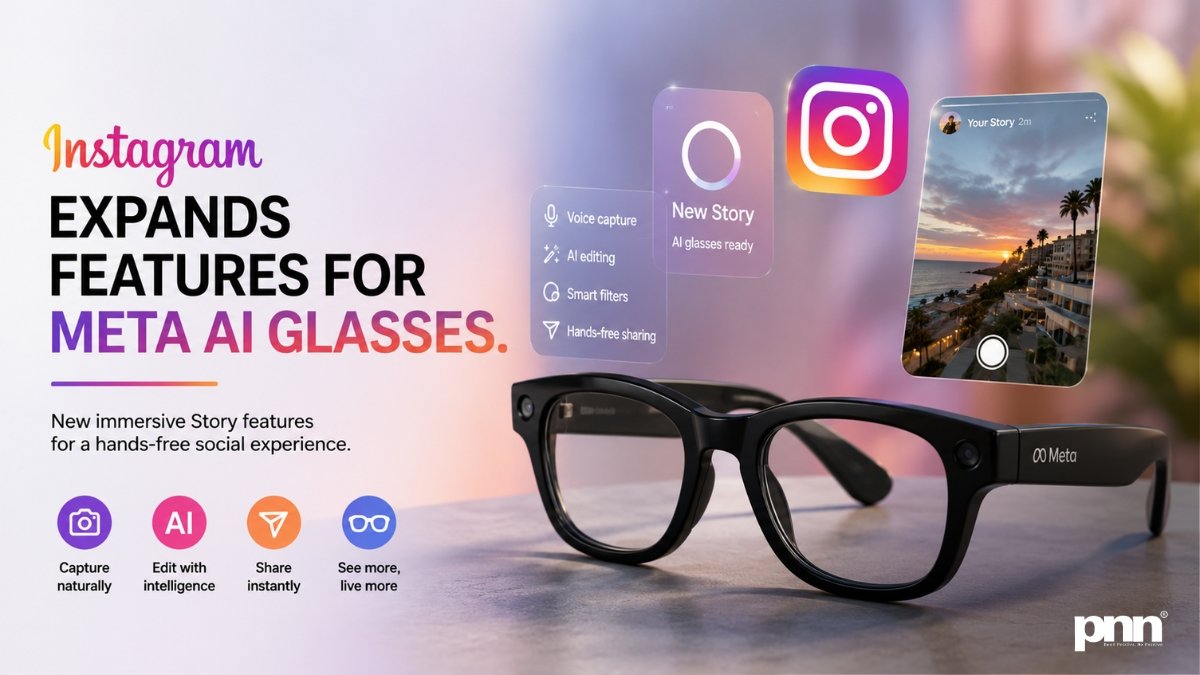
Mumbai (Maharashtra) [India], July 3: Social media has always demanded one thing: your attention. For over a decade, that attention has lived inside a smartphone screen, where every swipe, reel, and Story competed for a few more seconds of your day. Now, Meta appears determined to move Instagram beyond the phone altogether. The platform’s latest immersive Story features for its AI glasses ecosystem suggest that the future of social networking may not be in your hand—it may be sitting quietly on your face.
The announcement marks another significant milestone in Meta’s long-term wearable AI strategy, integrating Instagram more deeply with its smart glasses platform. Rather than simply recording videos, users will reportedly be able to capture, edit, and share Stories through AI-assisted interactions, creating a hands-free social experience that feels closer to real life than traditional content creation.
It is an ambitious vision.
After all, smartphones already consume enough of our lives.
Apparently, the next logical step is ensuring we don’t even have to hold them anymore.
Instagram Is Quietly Rewriting The Storytelling Rulebook
Instagram has evolved dramatically since its launch in 2010. What began as a simple photo-sharing application has transformed into one of the world’s largest digital ecosystems, serving well over two billion monthly active users across creators, businesses, and everyday consumers.
Stories, introduced in 2016, fundamentally changed how people documented their lives. Unlike polished Instagram posts, Stories encouraged spontaneous, temporary, and authentic moments.
Meta now appears ready to evolve that experience once again.
According to recent updates, the new Story features are being designed specifically for Meta AI-powered smart glasses, allowing users to record moments through voice commands, contextual AI assistance and wearable cameras rather than constantly reaching for a smartphone.
The objective isn’t simply convenience.
It’s to make technology disappear into everyday life.
Meta’s Bigger Wearable AI Ambition
Instagram’s latest features don’t exist in isolation.
They represent another piece of Meta’s much broader investment in wearable computing.
Over the past several years, Meta has invested tens of billions of dollars into Reality Labs, the division responsible for AI glasses, virtual reality headsets and mixed-reality technologies. While Reality Labs has reported significant operating losses exceeding $60 billion cumulatively since 2020, CEO Mark Zuckerberg has consistently described wearables as one of the company’s biggest long-term priorities.
The reasoning is straightforward.
If smartphones defined the past fifteen years…
AI wearables may define the next fifteen.
Rather than opening apps, future users may simply look, speak and interact naturally while artificial intelligence quietly manages the experience in the background.
Instagram becomes less of an application.
More of an extension of vision itself.
Why Stories Are The Perfect Testing Ground
Stories have always been Instagram’s most immediate form of communication.
Unlike carefully edited posts, Stories celebrate imperfection.
Coffee spills.
Concert clips.
Unexpected sunsets.
Embarrassing gym selfies that disappear before anyone remembers them.
Wearable AI fits naturally into that philosophy.
Instead of interrupting a moment to unlock a phone, frame a shot and apply filters, users could theoretically capture experiences as they happen through AI-powered glasses.
Content creation becomes frictionless.
The question, however, is whether friction was ever the real problem.
The Bright Side: Convenience Meets Creativity
For creators, influencers and businesses, wearable AI could unlock entirely new forms of storytelling.
Some of the biggest potential advantages include:
- Hands-free Story creation during travel, sports and live events.
- Real-time AI editing suggestions without opening multiple apps.
- More immersive first-person content for audiences.
- Faster publishing workflows for creators and brands.
For businesses, the opportunities extend beyond entertainment.
Retail demonstrations, restaurant experiences, tourism campaigns and educational content all become easier to document naturally without additional production equipment.
Instagram has always rewarded authenticity.
Ironically, it now wants technology to become almost invisible.
The Shadows Behind The Smart Glasses
Every technological leap brings equal measures of excitement and apprehension.
Smart glasses remain one of the most debated consumer technologies precisely because they blur the line between convenience and surveillance.
Several concerns continue to dominate discussions:
- Privacy implications when wearable cameras become commonplace.
- Questions surrounding consent in public recording environments.
- Potential misuse through hidden or passive content capture.
- Battery limitations and premium hardware pricing.
- Whether consumers genuinely want another connected device.
History suggests that revolutionary hardware isn’t guaranteed mainstream adoption.
Google Glass discovered that lesson rather publicly.
Meta hopes AI will change the ending.
The Business Behind The Vision
Instagram’s wearable integration is not merely a product update.
It is part of Meta’s long-term commercial strategy.
Advertising remains Meta’s primary revenue engine, generating well over $160 billion annually across its family of applications. Creating richer forms of content naturally increases engagement, creator activity and advertising opportunities.
At the same time, wearable devices open entirely new revenue streams through premium hardware, AI subscriptions and ecosystem services.
The investment may appear enormous today.
Meta seems convinced it will look inexpensive tomorrow.
More Than A Gadget—A Shift In Human Behaviour
Perhaps the most fascinating aspect of Instagram’s AI glasses isn’t the technology itself.
It’s the behavioural change they represent.
For years, society has criticised people for experiencing concerts, vacations and family gatherings through smartphone screens.
Wearable AI promises to remove that barrier.
Or perhaps simply relocate it.
Whether these new Story features become the next mainstream social experience or remain a niche experiment will depend less on the hardware and more on public trust.
People readily embrace convenience.
They hesitate when convenience starts looking back at them.
The Final Frame
Instagram’s latest wearable Story features a signal that Meta’s ambitions stretch far beyond social media. The company is attempting to redefine how moments are captured, shared, and remembered, replacing traditional smartphone interactions with AI-powered experiences that feel increasingly seamless.
Whether consumers are ready for that future remains uncertain.
One thing, however, seems increasingly clear.
The next battle for social media dominance may not happen on your phone.
It may happen right in front of your eyes.
Because in the age of wearable AI, the camera is no longer something you carry. It’s becoming something you wear.
