

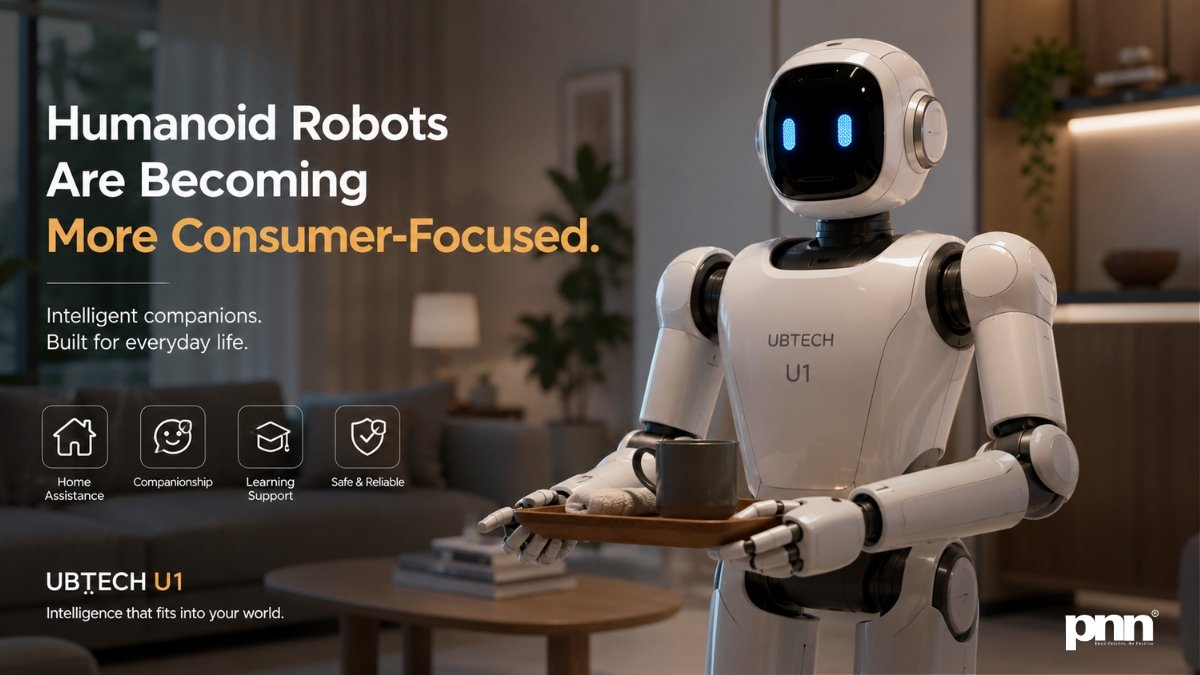
Mumbai (Maharashtra) [India], July 3: For years, humanoid robots have lived comfortably inside factories, research labs, and science-fiction films. They assembled cars, transported packages, and occasionally reminded audiences that machines taking over the world was always just two sequels away. Today, however, robotics companies appear to have a different ambition—not replacing factory workers, but becoming household companions.
Chinese robotics company UBTech has unveiled its new U1 humanoid robot series, a product aimed at bringing intelligent personal robots closer to mainstream consumers. The announcement reflects a growing shift across the global robotics industry, where companies are increasingly designing machines not only for industrial productivity but also for homes, education, healthcare, and everyday assistance.
The message is subtle but significant.
Robots are no longer being built exclusively to work for businesses.
Increasingly, they’re being designed to work for people.
From Factory Floors To Family Rooms
Humanoid robotics has evolved considerably over the past decade. Early development largely focused on manufacturing, logistics, and warehouse automation, where robots could perform repetitive tasks more efficiently than humans.
UBTech itself is no stranger to this evolution.
Founded in 2012 and headquartered in Shenzhen, the company has spent years developing robotics platforms for education, research, and enterprise customers. Its Walker series demonstrated advanced mobility and AI capabilities, while partnerships with automotive manufacturers showcased robots working alongside human employees.
The newly introduced U1 series, however, represents something different.
Instead of targeting assembly lines, it reflects the industry’s growing confidence that humanoid robots may eventually find a place inside ordinary households.
Apparently, the smart home wasn’t quite smart enough.
Now it’s getting legs.
Why Consumer Robotics Is Suddenly Accelerating
Artificial intelligence has dramatically changed what robots can accomplish.
Earlier generations relied heavily on pre-programmed commands. Modern humanoid robots increasingly combine computer vision, large language models, voice interaction, object recognition, and autonomous navigation, allowing them to perform more natural conversations and practical daily tasks.
As AI models become more sophisticated, hardware manufacturers are racing to create machines capable of bringing those digital capabilities into physical environments.
The result is a rapidly expanding market where humanoid robots are no longer viewed solely as engineering demonstrations but as potential consumer products.
Industry analysts estimate the global humanoid robotics market could exceed tens of billions of dollars over the next decade, driven by advances in AI, declining component costs, and increasing demand across healthcare, education and personal assistance.
The robot revolution isn’t arriving with dramatic explosions.
It’s quietly ringing the front doorbell.
The Opportunity Beyond Automation
Supporters argue that companion robots could solve several real-world challenges.
Ageing populations across many countries continue to increase demand for elderly care and personal assistance. Labour shortages persist in healthcare and domestic services. Families increasingly seek technology capable of assisting with routine household activities.
Potential applications include:
- Home assistance for elderly individuals.
- Educational support for children.
- Basic household task management.
- Interactive companionship.
- Smart home integration through voice-controlled AI.
Unlike industrial robots, consumer humanoids are being designed around interaction rather than production.
Their greatest value may not lie in lifting heavy boxes.
It may lie in making daily life slightly less complicated.
The Challenges Are Just As Real
For all the excitement surrounding personal robotics, the path to widespread adoption remains uncertain.
Humanoid robots remain expensive to manufacture, requiring advanced sensors, specialised actuators, powerful processors, and increasingly sophisticated AI software.
Privacy also remains a significant concern.
A household robot equipped with cameras, microphones, and continuous internet connectivity inevitably raises questions about data security, surveillance, and digital trust.
Additional challenges include:
- High purchase costs.
- Maintenance and software updates.
- Battery limitations.
- Public acceptance of humanoid companions.
- Ethical concerns surrounding AI decision-making.
Consumers may embrace intelligent assistants.
Whether they want one walking through the living room remains another question entirely.
The Bigger Industry Race
UBTech’s announcement also reflects broader competition across the robotics sector.
Technology companies worldwide are investing heavily in humanoid robotics, viewing the category as one of artificial intelligence’s next commercial frontiers. Major investments are flowing into AI hardware, robotic mobility, and autonomous systems, while governments increasingly support domestic robotics research as part of long-term industrial strategies.
The global robotics industry itself is already valued at well over $40 billion annually, with AI-driven service robots expected to become one of its fastest-growing segments throughout the coming decade.
The opportunity extends beyond hardware sales.
Software subscriptions, cloud services, maintenance contracts and AI upgrades could eventually become recurring revenue streams, making consumer robotics a long-term ecosystem rather than a one-time purchase.
The Human Question Behind The Machine
Perhaps the most interesting aspect of UBTech’s U1 launch isn’t the robot itself.
It’s what it says about changing expectations.
For generations, technology has helped people communicate faster, travel farther, and access information instantly.
Now it’s beginning to participate directly in everyday life.
The real competition isn’t between humans and machines.
It’s between technology that genuinely assists people and technology that merely impresses them.
If companion robots ultimately succeed, it won’t be because they resemble humans.
It will be because they prove useful enough that people stop noticing the difference.
The Final Thought
UBTech’s U1 humanoid robot series represents more than another product launch—it highlights the industry’s transition from industrial automation to consumer companionship. Artificial intelligence is no longer confined to smartphones or cloud platforms; it is steadily moving into physical machines designed to share our homes and routines.
Whether consumers are ready for that future remains to be seen.
One thing, however, appears increasingly certain.
The next member of the smart home may not be another speaker, another display or another app.
It may simply greet you at the door.
Hopefully remember where you left your keys.
